Showing posts with label Alzheimers behaviour. Show all posts
Tuesday, August 23, 2011
Bumps and bruises
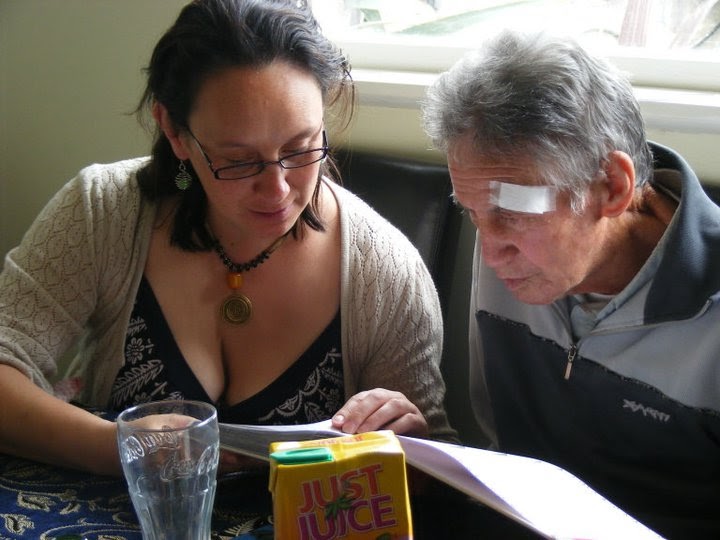
Every so often we would turn up and find Dad with plasters covering various bumps and bruises.
It did make us wonder what the heck sort of supervision was provided in the care facility.
On one occasion Dad was playing the piano and one of the gents took exception to it. I'll admit he's no Beethoven, not by any means, but he's never got a fat lip before because of his playing. Staff told us the gentleman in question was usually so quiet and he and Dad used to get along famously....Uh huh.
The two questions - How the heck did ths happen? and How can you make sure it won't happen again? were run by management. To be honest, I can't recall what their response was.
It's quite upsetting visiting your confused father with a swollen lip and plasters on his face. One does contemplate, just for a moment, finding the offender and giving him the evil eye. Though that's kind of childish and pointless. It's obvious he's stuck in the same hell condition as Dad and I can only presume, based on his outbursts at home, that Dad is not always nice as pie toward the other patients either. Energy is better spent on a positive visit with Dad who, by the way, has no memory of being biffed at all.
The fact is grown men thrown together will get on each others wick and get angsty - verbally or sometimes physically, either pushing and shoving or the occasional fisty cuff.
Most times the staff can intervene and send the boys to their corners long enough for them to forget they were shitty in the first place and no one gets hurt. Other times management had to call Mum and tell her the damage.
We've been told staff are on higher alert when the moon is full - the patients tend to get more aggressive then. I wonder if the first werewolf story was the result of an Alzheimer's patient going off?
It's quite hilarious, and slightly frightening, watching elder men setting to each other. I do wonder how they stay on their feet given their age makes them wobbly before they decide to throw a wide punch.
This makes Alzheimer's units sound like boxing rings. They aren't. The other factor that adds to bruising is age. Falls are common. And any bumps will show up on the skin - I have watched Dad try to force himself and his walker through tables and chairs because his mind was dead set on going that way. No amount of coaxing would change is course so he was left to bump his way through.
And sometimes it is necessary for staff to man-handle the men. They may be old, but they can also be stubborn and surprisingly strong when they decide to 'go off'. And man-handling the elderly, regardless of how carefully you try to do it, tends to leave bumps and bruises.
Tuesday, July 5, 2011
Lavendar Spray
One day we were visiting Dad when the staff had to use Lavendar Spray on him.
Actually, I think they used lavender on him fairly frequently when he first moved in. One of the reasons I liked this establishment was the fact they used alternative therapies with the clients. Their motto was to limit reliance on medication where drugs were not required.
I failed to ask a few pertinent questions, such as which alternatives, who was their consultant, what were their qualifications etc, etc.
Basically this place used aromatherapy, which meant a lot of lavender oil, and distraction techniques.
Unfortunately Dad wasn't exactly distract-able. At this point in time he was still aware enough to know he was not where he wanted to be. Home. With mum.
He still recognised the immediate family when we visited, even if it required a minute or two of prompting to get the actual name straight. He could also, occasionally, identify some members of the extended whanau. When friends visited, he usually didn't know who they were, but he pretended to.
That's one thing Dad was good at, making anyone who came to see him feel so welcome, like a long lost friend. It did take a few minutes for some visitors to click he had no idea who they were and was not keeping up with the conversation.
If Dad did get himself worked up into a state the staff would attempt distraction techniques and if that was looking unsuccessful they'd combine this strategy with spraying lavendar oil into the air around him. Always talking quietly and trying to get him onto some other thought.
I'm not sure how much the lavendar contributed to Dad eventually returning to his room, grumping all the way.
Of course, the Lavendar Spray technique to settle a stubborn Alzhiemers sufferer like Dad did not always work. On one occasion that I know of, because I was present, the staff decided to attempt some heavy handed tactics, which resulted in me and mum being upset and Dad using his walking stick as a weapon.
Fortunately common sense did prevail and everybody backed off till we had Dad sufficiently calmed down. It was fairly obvious the best remedy for Dad was Mum staying right beside him.
Personally I would have preferred if they also utilised homeopathy. They could have called in a homeopath, done a full consult on Dad and given him homeopathics.
But, because homeopaths are more expensive than aromatics Dad got to smell of a lot of lavendar spray
Monday, May 2, 2011
Settling Dad In
Settling Dad in to this first facility was a lot of work for the whanau.
The family visited as often as possible (which was quite a lot) because the unit manager was of the opinion that Dad needed familiarity to help him settle. This was different to most other places that ask family to stay away during the settling in period. We found the managers approach suited us just fine.
The major draw card with this facility, however, was the space and the views of the water.
Dad was still very mobile and he still liked to be outside. He may not have been able to cart wood, but he still thought he could - or at least he thought he wanted to.
On one visit home, Dad showed me a couple of viewing galleries he had made out the back using what ever he could get his hands on, which wasn't much. A couple of chairs, some tree branches, some metal found lying around.
One viewing spot was made by scratching soil out from around a tree root to create a flat area. He used a stick to build this area. He wasn't allowed tools and the unit hadn't quite managed to find the male gardener yet. This is the type of activity he was used to. This is what he wanted to do - not play scrabble.
We bought some paint so Dad could paint the back fence if he wanted. It turned out we spent more time painting than he did. He would come down with us and get started and then do what he used to do at home - leave us to it while he side tracked onto something else.
I have to say, the painting really was quite therapeutic.
But Dad still cried. He wanted to know why he was there. He asked what had he done to deserve being left here. He wanted to know when he was going home. He wanted to know why Mum wasn't staying with him.
Some days he convinced himself he was on a marae with a group of other people.
One day he made us laugh when he said, "Isn't it great to have a place like this for all those people" indicating a couple of obviously challenged residents. There was, of course, absolutely nothing wrong with him.
It would be nice to say he eventually settled into the place. At the very least it did become familiar to him.
But mum found it hard to leave him there. I think she also found the conditions a little hard to take.
The thing with dementia units is that they do tend to smell of pee. No matter how hard a unit might try, someone will still pee somewhere - I'm referring to the men mostly. Dad used to pee off the verandah onto the grass because...well, mostly just because.
This unit was quite old - it still had carpet in the hallway which did tend to reek if someone thought the corner in the corridor looked like a great place for relief and the aroma of pee does get to you after a while.
Long story short, after a few months Mum decided Dad hadn't settled as well as she'd hoped, though mostly I think she was feeling a little guilty for putting him there, so she pulled him out and took him home.
Saturday, April 16, 2011
Favourite Verses
I was reminded, on my trip home recently, of another of Dad's favourite verses.
For I am persuaded that neither life nor death, nor angels nor principalities nor powers, nor things present nor things to come, nor height nor depth, nor any other created thing, shall be able to separate us from the love of God which is in Christ Jesus our Lord. (Romans 8:38-39)
The family have put together a couple of albums and booklets for Dad (our niece even made a photo album for a Christmas present) and this verse was in one of them. He can read these albums at his leisure, or we get them out when we visit - to attempt to keep him remembering his family.
To date the books have managed to stay in Dad's dresser where he can easily access them but out of view of others.
The quirky thing about Alzheimers homes is that the residents will wander. They'll sleep on each others beds and help themselves to each others clothes, shoes and other belongings.
Dad is no exception to this behaviour. In fact, because he is a bit of a magpie, I'm guessing he's one of the worst offenders. It was not unusual, when visiting, to have to escort him out of someone else's room or find him dressed in clothes that weren't his.
Some facilities try to prevent this communal sharing of private property by locking all the bedroom doors during the day. Others accept that this behaviour is normal and request, quite sensibly, that all belongings be clearly labelled. Then when found elsewhere they can be returned to the correct room, eventually.
We decided to go for the communal sharing mind set. There is something not nice about locking old confused people out of their rooms during the day. Does it really matter if they don't quite make it to the right room now and then, or if they help themselves to something that takes their fancy.
Considering what this disease does to them, why not let what belongs to someone else bring them a little joy for a little while.
One can only hope that, should they hoist Dad's books, they'll like his favourite songs and verses as much as he did.
Monday, March 14, 2011
Dad's Singing
Dad was reading and writing and singing when I visited him today.
This is big news. Dad has not written for quite some time. He used to write a lot. It was great to see him reading - he hasn't done that for a while either.
The whanau have made a few photo albums with pictures and clippings and favourite verses for Dad to look at while he's in care. We take them out when we visit partly for something to talk about, partly to test his recognition.
Today the writing barely made sense, but the reading went quite well I thought.
I've been here for a few weeks visiting Dad. For the last few visits he has been quite out of it. Partly with drugs, partly his condition, partly the time of day - mornings are much better.
Today he had just had a massage courtesy of my sister and her partner. Whether or not this had an effect on his mental faculties I don't know - he may have just been having a good day.
It might be worth noting that the facility had auditors visiting today, so maybe they had cut back on the 'keep them calm' drugs for the patients. I wonder if we'll ever find the answer to that. Maybe I'm just being cynical and not nice. Dad certainly didn't look as doped up as usual. It's easy to tell when he's under the influence of excess medication - he has cloudy eyes.
One thing I have deduced is that Dad still responds to music. So I often sing when I visit. He sometimes recognises the tune and sings along. My sister was singing during his massage today and quite possibly had warmed up his memory and vocal chords. He sang along to the verse he'd just read.
It's a far cry from how Dad used to read and sing but it makes everybody feel good to see he still has it.
This is big news. Dad has not written for quite some time. He used to write a lot. It was great to see him reading - he hasn't done that for a while either.
The whanau have made a few photo albums with pictures and clippings and favourite verses for Dad to look at while he's in care. We take them out when we visit partly for something to talk about, partly to test his recognition.
Today the writing barely made sense, but the reading went quite well I thought.
I've been here for a few weeks visiting Dad. For the last few visits he has been quite out of it. Partly with drugs, partly his condition, partly the time of day - mornings are much better.
Today he had just had a massage courtesy of my sister and her partner. Whether or not this had an effect on his mental faculties I don't know - he may have just been having a good day.
It might be worth noting that the facility had auditors visiting today, so maybe they had cut back on the 'keep them calm' drugs for the patients. I wonder if we'll ever find the answer to that. Maybe I'm just being cynical and not nice. Dad certainly didn't look as doped up as usual. It's easy to tell when he's under the influence of excess medication - he has cloudy eyes.
One thing I have deduced is that Dad still responds to music. So I often sing when I visit. He sometimes recognises the tune and sings along. My sister was singing during his massage today and quite possibly had warmed up his memory and vocal chords. He sang along to the verse he'd just read.
It's a far cry from how Dad used to read and sing but it makes everybody feel good to see he still has it.
Tuesday, February 1, 2011
Frequent Questions.
As his condition really started to set in, the most noticeable thing, for us kids anyway, was the frequent questions. Dad was repeating questions. The same questions. Constantly.
Do you know where your brother is today?
He's at home Dad.
Oh, is he. That's good.
So you know where he is, do you?
Yes Dad. He's at home, doing stuff.
Oh. That's good he's doing things.
Where is he while he's doing these things?
He's at his place.
Oh. That's good.
Tell me, just one last time, I probably asked before. Your brother is at home?
Yes Dad.
Ok, just one more time and then I'll be quiet. Where is your brother today?
Ummmm - You want a cup of tea Dad??
My brother and law came to visit one day and he said, ‘what would happen if you didn’t answer him when he asked for the 3rd time?’ I had to say, I’d never thought of that. I presume he’d just keep asking, or he’d ask another question.
I do know, though not as well as my mother knows, that living with constant, repetitious questions is very, very draining. We short term visitors, which is how I’d label Glenn and myself, because we only turned up at home for a little while every couple of days, offered Mum a bit of a reprieve.
We also became very good at rephrasing the same reply. Why? Well, it got darned boring saying the same response over and over again. And I thought that maybe, rephrased, the answer may resonate somewhere in his mind and stick.
But, as I’ve said before, with no resident expert offering salient advice, I have no idea if anything we were doing was right.
The only thing we knew for sure was he’s our Dad and regardless of any ups and downs we may have had, we love him heaps and we don’t think he deserves this bloody disease.
I haven't seen your brother today, have you?
Dad, you already asked me that question.
Did I? What was your answer to my question then.
![]() |
| The brother in question. |
Monday, November 29, 2010
Safety and Sanity Move
When it comes to Alzheimers, it's not just the sufferer whose sanity and safety is of concern.
My sister came to stay at Mum’s place, as live in help with Dad. She came with her two youngest boys.
I’ll admit we weren’t sure this was a good move. Dad liked his house his way. Having extra people around, especially lively young boys, was bound to get up his nose. But mum was adamant everything would be fine. She can be a stubborn woman sometimes.
Mum was, and still is, involved in local community activities. I think she wanted someone around, someone who Dad knew, someone she was comfortable with, to take the attention off her and keep Dad happy and occupied while she did her own thing.
Sounds good in theory, but everybody has a life to live and that included my sister and her boys. Mum did enjoy their company and my sister did help take a load off in a lot of ways but, as time went on, Dad got worse in his acceptance of ‘others’ in the house. He started to view the boys rather negatively.
I’m not sure, actually, if he was jealous - they were interference to his direct access to mum. There were times, I'm sure, when he thought he should be the only one who was allowed her attention. Or whether he saw them as a reminder of his loss of control. Not only was his mind playing tricks on him but he no longer ruled his own home. The dynamics of who was in charge in the household had moved away from him, to Mum.
He thought he should be able to tell these boys what was what and they should listen. They eventually figured out it’s best to stay out of the way, which is hard to do when you all eat together. A TV room was created upstairs so they could get some peace and distance themselves from any craziness downstairs.
I give them their dues. They were living at mum's for a while and many times were able to take humour out of less than humourous situations. Rehua would recount, with a twinkle in his eye and a laugh, Poppa's getting mad over something he himself considered pointless, like having breakfast.
Dad- have your breakfast
Rehua- I've had breakfast
Dad - You have to have breakfast
Rehua - But I've already had breakfast.
Dad made lots more rumblings about having breakfast.
Rehua, from memory, went and had more breakfast, which for a growing boy suited him just fine.
Though some things could be taken with humour, I would hazard a guess that a childs patience and understanding of an angry Poppa wears thin eventually. Especially when the bad, seemingly irrational mood rears it's head too often.
Dad’s frustration with whatever was, or was not, going on in his head, made him angry. His Alzheimer’s, that’s what I’m blaming anyway, made him harder to deal with and pacify.
Apparently there comes a point where, if you can distract an Alzheimer’s sufferer long enough, they’ll forget what annoyed them and you can move them on to another activity. Dad was not at that point.
Once he got an idea in his head it could be difficult to shift him. It was as if the idea went round and around like a looped message with no stop button. And if you did manage to distract him, it was temporary. The recording would start again. It seemed the only thing that distracted him was a new looping message and we hadn’t figured out how to start one of those.
Usually Dad took his frustrations, when they built up, out on Mum. Shouting, mumbling, glaring and threatening. Eventually he could no longer contain himself and his anger spilled over to the boys.
It’s sad to think that the boys’ memories of Dad may well be little more than an old angry man.
It was time to move them out of the house, for their sanity and safety.
It’s sad to think that the boys’ memories of Dad may well be little more than an old angry man.
It was time to move them out of the house, for their sanity and safety.
Friday, November 26, 2010
Taking Random Pills
Mum discovered one day that Dad would pick up any random pills he found lying round the place and take those.
I’m not actually sure if he knew what his pills were for, he just knew he was supposed to take pills. So, if he came across a bottle of tabs, he’d ponder if he’d taken his today, decide no, and take what was on hand.
And what was on hand? Mums’ pills, past their due date pills, tabs from old and changed scripts. And, according to hubby's memory, a very old bottle of my grandmothers pills – and she’s been gone for a while. I have no idea where Dad had been scrummaging to find those.
When mum went on her holiday, there was a bottle of Dads pills on a shelf in the kitchen. Mum had pointed them out before she left. I presumed Dad took them as a daily routine, he was, as far as I knew, still capable of that. My presumption may have been a little off track. One day when Dad found a bottle in the bathroom and returned it to the spot on the kitchen, he was perplexed as to why there were two bottles there. Plus the one’s on the table in the lounge, next to his chair. He queried which ones we thought he should take.
Which ones are yours Dad?
These I think
Is your name on them?
Oh, that would help wouldn’t it?
I looked at what he was holding. The label on one bottle, the one he was more focused on, was so worn you couldn’t read it and the edges were coming unstuck from the plastic. Using deduction I suggested he take the newer tabs, the ones with his name on that you could read. I should have biffed the other ones, but didn’t. Instead I put them in bathroom cupboard with the rational ‘these must belong to somebody’.
When mum got back from her trip and we told her about his crying she told us Dad often got upset over things, but not as extreme as we were describing. She took him to the doctor who decided it must be his blood pressure playing up, so changed his pills. That’s when we mentioned the pill story to Mum and she recounted her tales of catching him taking her tabs, or roaming around the house with tablet containers of unknown origin, or taking more tabs when she’d already given him his daily dose.
It’s just as well we aren’t a seriously sick bunch up north – well, not physically anyway, or lord knows what he’d have been taking.
It was time to empty the house of all unnecessary, unnamed, out of date pill bottles, because there were a few lying around. Coincidentally, the local health promotion team were spreading the message to check your pills and clear out any non-current scripts. Timely. The chemist also organized for blister packs, complete with current dates, so mum could tell whether Dad was keeping up with his meds.
These were good strategies as far as managing his medication and reducing the taking of random pills was concerned, but I don't recall it helped him much...Dad kept crying.
Sunday, October 31, 2010
Who You Gonna Call?
If you ever lost your memory, who would you call?
One thing that Mum noticed early on about Dad, was how he wanted her to stay close by, especially when they were out. That was a little unusual. Dad was a walker, a wanderer. Find him a market, a second hand shop, a place he's never been before and he'd be lost in discovery.
It took a while, but his confidence with things like being out shopping on his own started to decline. Consequently, his dependence on mum increased.
I’m not talking being alone in a major city here. I mean being unable to find his way back to the car in their little country town.
So, Mum ended up having to be very close by. In fact as his Alzheimer’s progressed, Dad wanted to have her front and center almost constantly. When he couldn’t get that he’d have one reaction. He’d panic.
I remember visiting town one day. Mum and Dad pulled up at the grocery store. She pointed us out to him on the other side of the road. We waved to each other and he started to head in our direction. Mum took our presence as an opportunity to slip off to the shop alone as Dad was wandering over. He hadn’t seen her go the other way and when he realized he looked round searching. He looked as though he had no idea what to do. His lifeline had done a runner.
He spun round again, saw us as if for the first time that day, and came racing over as fast as his old legs and walking stick would let him, in a real panic. ‘Have you seen my wife?’
Yes Dad. She’s gone into the shop.
Has she? You’re sure about that?
Yes Dad. You want to come with me. I’m going to buy a coffee. I’ll shout.
What about Pat. What about my wife?
She’ll find us Dad. And if she takes too long, we’ll just have another coffee – and you can buy that one.
Can I now?
Yep.
I do wonder what must have happened the first time he got ‘lost'.
Imagine being lost in a place you’ve always lived. Lost on the street you’ve just walked down. Looking at people you've known for years and thinking they're strangers.
Imagine the panic. The confusion.
Imagine having to walk up to people, who you may know, and saying, ‘How do I get home?’
What must people think when you do that?
That’s one good thing about being part of a small town, they know who to call.
Tuesday, October 26, 2010
Brush my boat....I'm going to church.
Dad started mixing his words - brush my boat, where's my dragon....It sounds humourous, and in fact taken on its own, it is humorous. But there were times when it's just sad.
Dad was struggling with what was happening to him.
He’d often say ‘I think I’m having problems with my memory’. I’d just say, ‘Yes you are Dad, but that’s cos you’re old. It’s an aged person’s problem.’ I didn’t see the point in telling him he had Alzheimers. Maybe I was wrong, but his diagnosis did not result in reams of information being laid at our doorstep about what to do and how to go about it.
Some days you could see his frustration with his condition. Imagine knowing that you know something, but you can’t for the life of you remember it…..
One day he called me into the kitchen, pointed at the gas hob and said ‘What is this thing for?’
It’s for cooking dad. You cook food on it.
That’s right. And what’s it called again.
It’s a gas hob Dad.
That’s right…
I can’t begin to imagine what it must be like to find your understanding slipping away like that. To lose your ability to carry out simple, basic activities that you’ve done for years because the knowledge is there in the haze of your mind, you know it is, or it should be, but you just can’t grasp it and hold to the forefront of your thinking.
Before I left for Saudi, Dad was replacing intended words with others. For example,’ I have to go brush my boat’. (hair). It is very easy to dismiss him as being completely loopy when this happens and, when you can’t get the right words from him, or figure them out (Brush your boat Hiwi? What do you mean, I don’t know what mean by that?) and walking away.
I’m glad our family has the ability to see humour in this Dad's situation.
‘Why Dad are you going fishing? I thought you were going to church’.
‘Oh, is someone going fishing?’
‘No Dad, you’re going to church, but you better go brush your hair.’
‘Yes, that’s what I was doing. I’d like some fish though.’
The first time I saw him muddle his words so badly the sentence made no sense at all, he got frustrated. No matter how he tried, he couldn’t communicate his intent. I’m not sure if his frustration was because we could not understand him, or because he figured out he was using the wrong words.
Having difficulty following a conversation when people spoke too fast kicked in some time ago.
We got an email from my sister recently and she said that finally the nursing staff have realised that he needs time to compute what is being said.
If you don’t mind silence while computation is occurring and if you don’t mind repeating the information slowly in simple bite size pieces, you will get an answer eventually.
Sunday, October 24, 2010
Health care deficiencies - the last thing we need.
Dad used to walk, almost daily, it kept him healthy and fit.
The latter few years he'd take a walking stick with him. He had a few - anything from home made tea tree or a bamboo stick with rubber stuck on the end for the handle through to well crafted, purchased varieties.
![]() |
| Mum, Dad, moko's and one of the walking sticks. |
He and Mum lived in a small northland town and he would take the dog for walks down to the bridge and back. It’s actually a wonder neither of them got run over. The house is by a main road north, so there can often be a bit of traffic and it moves very fast, especially when them city folk are heading to their northland beach houses over weekends and holidays.
My sister bought him a reflective jacket one day for safety. I don’t think he wore it much.
As his Alzheimer’s progressed, the amount of time he spent walking down the road decreased, though that took a while. Walking down the highway was something he had done for a number of years. I’d say walking was wired into his programming and it probably contributed to his good physical condition.
They say that ingrained patterns tend to stick in the memory the longest. So, for quite some time post diagnosis, he still walked, sometimes late at night. And Mum would worry where he was. On more than one occasion someone in the whanau would hop in the car and go find him, just to make sure he was OK.
I’m not sure at what point he stopped walking down the road, but up until his physical health took a turn for the worse a few weeks ago he still liked to be moving and active. Or at least, he liked the idea of being moving and active.
We had difficulty finding the right place for Dad when the conclusion was reached that Mum could not care for him at home anymore.
Of course this wasn’t helped by the fact that his assessment was wrong. An assessment made by a relieving doctor who didn’t come and visit Dad, he merely read a few notes and, when we had questions about his assessment, was unavailable to review it until the New Year.
We were being introduced to the machine that is our health care for the elderly.
And we were finding its deficiencies.
When your father is assessed with Alzheimers, and your mother is suffering the stress of that diagnosis, and the emotional turmoil of having to admit your husband for care, the last thing you need is machinery deficiencies.
Saturday, October 23, 2010
Apple Pie, Globalisation and Hind Sight.
We love mum.
Mum is a real special lady.
She makes the best apple pie in the world....
Dad's Alzheimers has tested her.
We probably don't really know how much.
When it was first suggested that Dad might be in the early stages of Alzheimers, I don't think any of us actually realised the impact this disease would have on him.
When he eventually was diagnosed, I'm not sure that mum believed he had Alzheimers. And I'm fairly certain that none of us, mum in particular, realised what an impact this would have on her.
In the interval between resigning from his job and just prior to his diagnosis, Mum did mention she had noticed a couple of changes in his behaviour. One of them, she said, was he had started to lack confidence when meeting people. That was unusual. Dad used to love meeting people. He was a people person.
One of his more common topics at functions, he often got requests to speak, was the importance of respecting and embracing other cultures and what they had to offer our own country and maori in particular. He and mum were involved in organisations, and in fact set up one that still operates today, that specialised in inter-cultural relations.
If we'd been looking for the onset of Alzheimers as Dad got older, maybe we'd have known that reptition of a topics is a sign. Along with confusion of concepts. But I for one presumed Dad would grow old with grace, with just the typical golden years issues, so wasn't keeping an eye out.
In the years preceding his diagnosis, and it was a few years, it was a bit of humour at family functions to wonder what speech Dad would make, because being head of the whanau and a man with mana, it was expected he would make speeches.
Would he talk about embracing other cultures (he often did), would he quote his favourite passages from the bible, would he talk about the 'global family'. We found this humorous because he was speaking at family birthdays or weddings. Not really the right sceme for a topic like globalisation. And once he started talking, what would he say? And when would he stop? He would often repeat himself and his repetition took him round and round.
You see, he was already exhibiting symptoms, we just didn't register it as serious. He was getting on in years after all.
It's only now, in hindsight.....
Mum is a real special lady.
She makes the best apple pie in the world....
Dad's Alzheimers has tested her.
We probably don't really know how much.
When it was first suggested that Dad might be in the early stages of Alzheimers, I don't think any of us actually realised the impact this disease would have on him.
When he eventually was diagnosed, I'm not sure that mum believed he had Alzheimers. And I'm fairly certain that none of us, mum in particular, realised what an impact this would have on her.
In the interval between resigning from his job and just prior to his diagnosis, Mum did mention she had noticed a couple of changes in his behaviour. One of them, she said, was he had started to lack confidence when meeting people. That was unusual. Dad used to love meeting people. He was a people person.
One of his more common topics at functions, he often got requests to speak, was the importance of respecting and embracing other cultures and what they had to offer our own country and maori in particular. He and mum were involved in organisations, and in fact set up one that still operates today, that specialised in inter-cultural relations.
If we'd been looking for the onset of Alzheimers as Dad got older, maybe we'd have known that reptition of a topics is a sign. Along with confusion of concepts. But I for one presumed Dad would grow old with grace, with just the typical golden years issues, so wasn't keeping an eye out.
In the years preceding his diagnosis, and it was a few years, it was a bit of humour at family functions to wonder what speech Dad would make, because being head of the whanau and a man with mana, it was expected he would make speeches.
Would he talk about embracing other cultures (he often did), would he quote his favourite passages from the bible, would he talk about the 'global family'. We found this humorous because he was speaking at family birthdays or weddings. Not really the right sceme for a topic like globalisation. And once he started talking, what would he say? And when would he stop? He would often repeat himself and his repetition took him round and round.
You see, he was already exhibiting symptoms, we just didn't register it as serious. He was getting on in years after all.
It's only now, in hindsight.....
Friday, October 22, 2010
How To Raise Baby Dragons
In 2005 we decided to leave Melbourne, Australia and move home. We'd been away for seven years.
Just prior to our return, Dad had stood down from his role as Chairman on a local baord and was 'retired'. He was keeping himself busy with little projects - going to the farm to pick grapes, building this and that around the house, reading and writing.
At some point after our return home, we were told about the little things which contributed to Dads standing down. He would go off on tangents in discussions, his memory wasn't the best....you know little things that are usually attributed to aging, but which people identified as 'affecting work performance'.
I think Dad was early to mid 70's and still working. It seemed reasonable that he would be showing signs of age. A little memory fade here and there, nothing major. At least that's what it looked like to us. Physically he was still in very good condition.
Soon after we had settled back home, Dad started painting a dragon on the wall in the hallway. It was a bit of a joke with the whanau. Mum, who I have decided is a saint, just let him go for it.
You have to realise that Dad, with all his building projects, is not a builder, nor would I qualify him as an artist. Glenn says he learnt alot from Dad about 'giving things a go'. In his retirement, he was doing just that. Whatever came to his mind he would give a go. Whatever came to his mind.....
Dragons were his latest focus. We probably should have heard alarm bells ringing when he started asking where he could find a book on how to raise baby dragons.
Just prior to our return, Dad had stood down from his role as Chairman on a local baord and was 'retired'. He was keeping himself busy with little projects - going to the farm to pick grapes, building this and that around the house, reading and writing.
At some point after our return home, we were told about the little things which contributed to Dads standing down. He would go off on tangents in discussions, his memory wasn't the best....you know little things that are usually attributed to aging, but which people identified as 'affecting work performance'.
I think Dad was early to mid 70's and still working. It seemed reasonable that he would be showing signs of age. A little memory fade here and there, nothing major. At least that's what it looked like to us. Physically he was still in very good condition.
Soon after we had settled back home, Dad started painting a dragon on the wall in the hallway. It was a bit of a joke with the whanau. Mum, who I have decided is a saint, just let him go for it.
You have to realise that Dad, with all his building projects, is not a builder, nor would I qualify him as an artist. Glenn says he learnt alot from Dad about 'giving things a go'. In his retirement, he was doing just that. Whatever came to his mind he would give a go. Whatever came to his mind.....
Dragons were his latest focus. We probably should have heard alarm bells ringing when he started asking where he could find a book on how to raise baby dragons.
Subscribe to:
Posts (Atom)


